
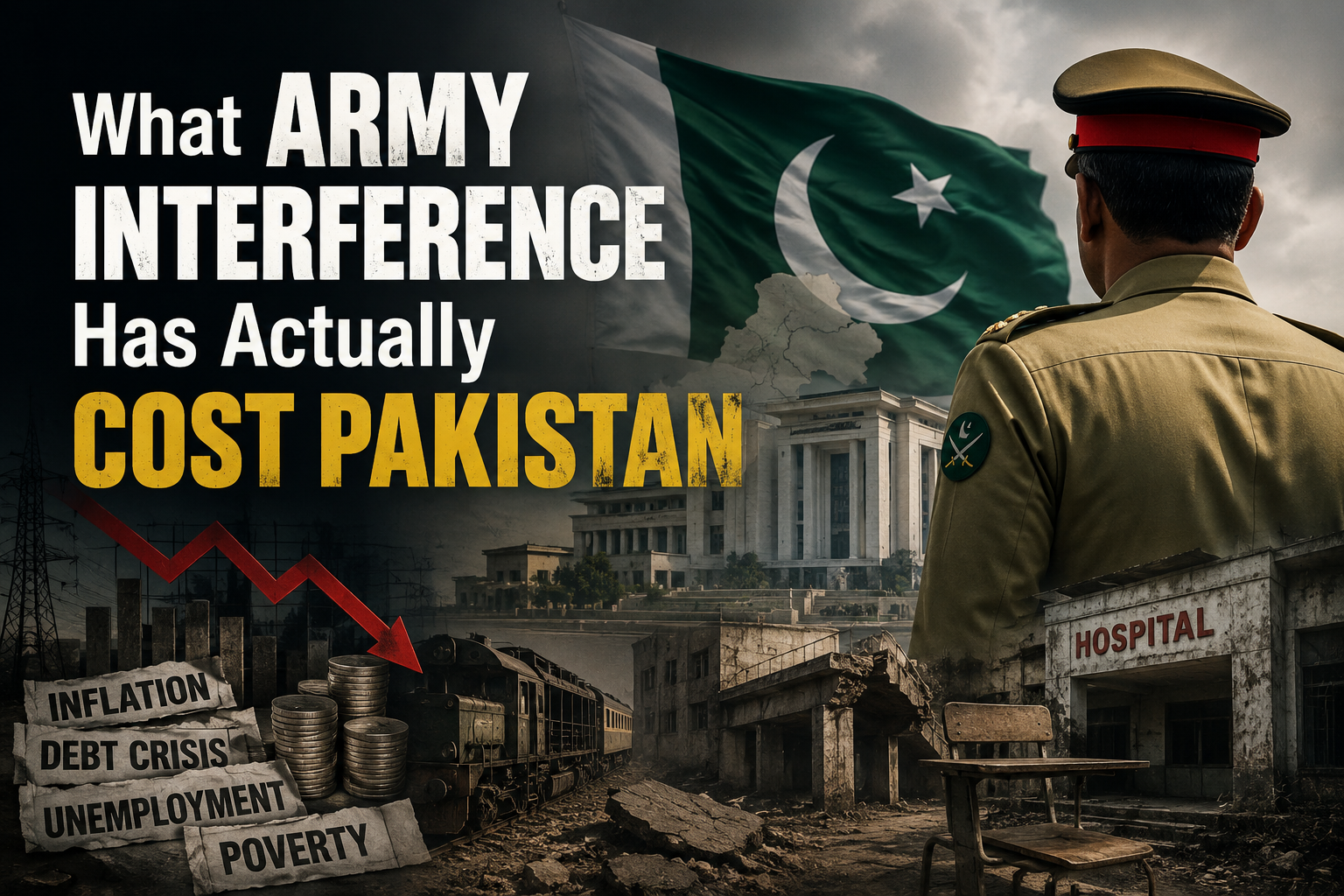
Pakistan’s story since independence keeps circling back to one thing: the army never fully let go of the wheel. A general has sat in charge directly for roughly a third of the country’s history. For most of the rest, an elected government sat in Islamabad, while the decisions that actually mattered on foreign policy, on national security, on who got to stay in power, were made a few miles away at GHQ in Rawalpindi.
It started in 1958. Eleven years after independence, army chief Ayub Khan took power in a coup and stayed until 1969. Hardly anyone brings this one up anymore. But it’s probably the moment that mattered most, because it taught every general after him that an election was optional. You just had to decide to take over, and the country would adjust.
The next coup did more damage. What began in 1971 as a political crisis over an election result in East Pakistan turned into a military crackdown, then a war with India, then the loss of half the country, which became Bangladesh. Pakistan surrendered roughly 93,000 troops, one of the largest surrenders of the twentieth century, and lost more than half its population and a huge share of its economy in a single year. General Yahya Khan was in command throughout. Historians can spend all day debating whether Pakistan ever won a war outright. Nobody debates 1971.
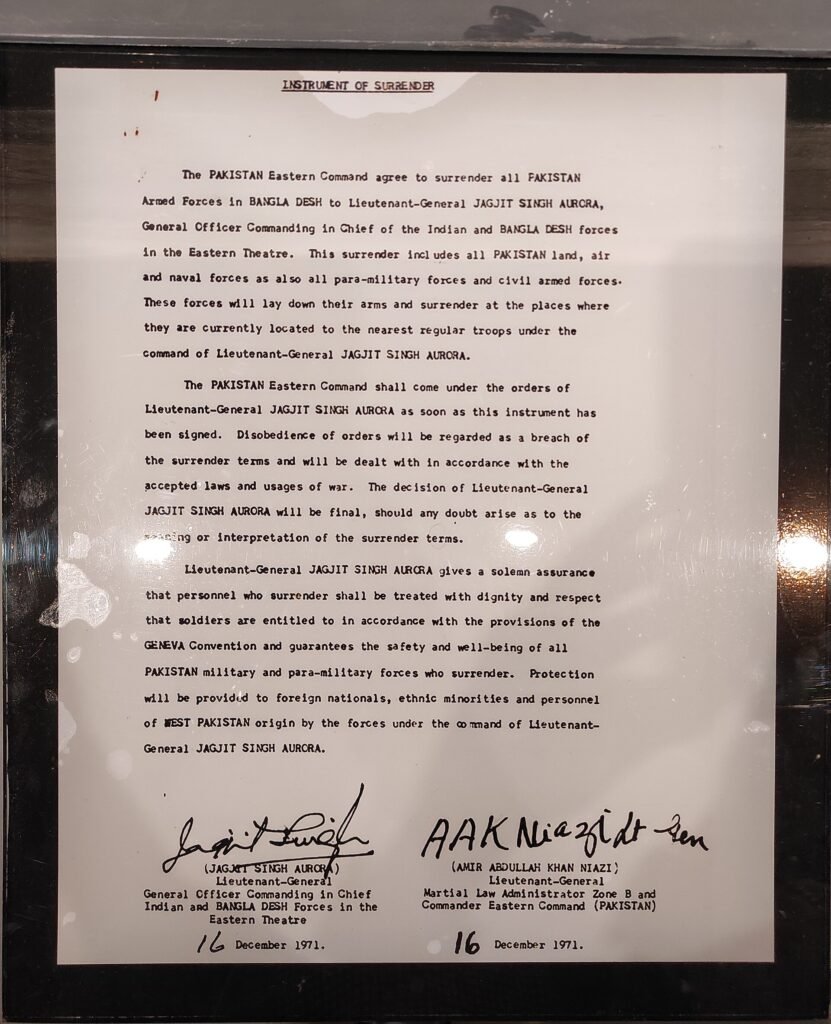
Pakistani Instrument of Surrender (16 December 1971), copy of the document held at the Bangladesh Military Museum, Dhaka. Photo by Niasoh, via Wikimedia Commons, licensed under CC BY-SA 4.0.
Zulfikar Ali Bhutto’s civilian government followed, briefly. Then General Zia ul Haq took over in another coup in 1977. Two years later he had Bhutto, an elected prime minister, hanged, after a trial most historians describe as rigged from the start.
Zia ruled under martial law through most of the 1980s. That decade reshaped Pakistan in ways still visible today: the Islamisation of the legal system, and the deep entanglement of Pakistani intelligence in the Afghan war against the Soviets, bankrolled by the US and the Gulf states. A sitting prime minister had already been hanged. The message to everyone who came after was not subtle.
The third coup came in 1999. Pervez Musharraf seized power, pushed out Prime Minister Nawaz Sharif, and stayed until 2008. This was the era of the war on terror, when Pakistan told Washington it was an ally while parts of its own security establishment kept separate relationships with militant groups on the side. That contradiction damaged the country’s credibility abroad for years. By the time Musharraf stepped down, Pakistan had spent close to half its entire existence under direct military rule, across three separate stretches.
Alongside the coups, the army quietly built one of the largest business empires in the country. This is documented in detail by the scholar Ayesha Siddiqa in her book Military Inc. The Defence Housing Authority developments, Fauji Foundation’s cement, fertiliser and banking arms, and the Army Welfare Trust together hold assets worth billions. Serving and retired officers run most of it. None of it shows up on any public defence budget. Land handed out for military housing has a habit of turning into prime commercial real estate a few years later.
Balochistan gets talked about the least. It’s probably the part that costs the most in human terms. For decades, security operations there have been framed publicly as counterinsurgency against separatist groups. Under that framing, the UN’s own Working Group on Enforced Disappearances, along with Human Rights Watch and Amnesty International, have documented thousands of cases of Baloch activists, students and journalists who were picked up and never seen again, or turned up dead months later. Families have sat in protest camps in Islamabad and Quetta for years asking questions nobody answers. Officials deny state involvement. The pattern has held for over a decade regardless.
2022 is the one most people only started paying attention to after it happened. Imran Khan was removed from office that April through a no confidence vote in Parliament, a constitutional process on paper. The Financial Times and Reuters both reported at the time that the military establishment had pulled the backing that helped bring Khan to power in 2018. Once that support was gone, his coalition fell apart within weeks.
Khan himself has claimed publicly that Washington orchestrated the whole thing, angered by his outreach to Russia during the Ukraine war and a visit that happened to coincide with rising oil prices. That claim has never been independently verified. Both the US State Department and Pakistan’s own military spokesman have denied it outright. It belongs in this story as Khan’s allegation, not as settled fact. What happened next is not in dispute: Pakistani authorities arrested thousands of his party’s supporters through 2022 and 2023, a crackdown documented at length by Human Rights Watch, Amnesty International and most international outlets that covered it.
The smallest story here might say the most about how little room Pakistan has to make its own decisions. In 2010 Pakistan signed a deal with Iran for gas priced lower than anything else on offer. More than a decade later the pipeline still isn’t built. Islamabad has never been willing to risk the US sanctions that come with doing business with Tehran, and Pakistan has paid penalties for the delay. The gas sits on the other side of a border it shares with Iran. Still unusable. Somewhere along the way, someone decided crossing Washington wasn’t worth it.
Pakistan has held regular elections since 2008. The families still sitting outside the press club in Quetta, holding photos of sons who never came home, would tell you what that’s actually worth.
“Do not forget that the armed forces are the servants of the people. You do not make national policy; it is we, the civilians, who decide these issues and it is your duty to carry out these tasks with which you are entrusted.”
Muhammad Ali Jinnah, address to officers at the Army Staff College, Quetta, June 14, 1948
Leave a Reply